
It’s 7:00 AM on Sunday, but a conversation with Demi Moore is worth waking up early for. She’s bright-eyed as she asks for my name and outlet. “That’s my job, Demi!” laughs a publicist. “Okay,” Moore answers with a slight smile. Without missing a beat, she resumes the spiel: “And he’ll give you a two-minute warning.” Still laughing, the publicist confirms what Moore has just said.
Her poise is no surprise. Coming of age under the flashy neon lights of the 1980s, Moore is a star in every sense. She featured on posters for decade-defining dramas and comedies from St. Elmo’s Fire to About Last Night… before moving on to 1990’s Ghost, followed by roles in A Few Good Men, Indecent Proposal, and Disclosure. Moore ventured onto the other side of the camera, too; she produced and starred in HBO’s three-part anthology, If These Walls Could Talk, with Cher and Sissy Spacek. By 1996, Moore was Hollywood’s highest-paid actress, earning enviable cheques for her work in Striptease and G.I. Jane (1997).
Become an S Insider
The latest in fashion, beauty, design, and arts & culture.

Yet, as Moore’s career soared, controversy followed. In a 2024 interview with The New York Times, the actor reflected: “With Striptease it was as if I had betrayed women, and with G.I. Jane, it was as if I had betrayed men. But I think the interesting piece is that when I became the highest-paid actress—why is it that, at that moment, the choice was to bring me down?”
It’s a tale as old as time: they build you up to break you down. Yet this very topic spurred Moore’s resurgence. Opposite Margaret Qualley in 2024’s The Substance, Moore became Elizabeth Sparkle—an aging actress whose below-the-market beauty treatment begins to unravel. A body horror film, the picture is packed with visceral, close-your-eyes moments. What’s more unnerving, however, is the conversation beneath the spectacle.
Returning to the Paramount+ series Landman as Cami Miller, Moore’s role explores age and identity in a different context. Still reeling from the loss of her husband, an oil tycoon by the name of Monty Miller (Jon Hamm), Cami must contend with her grief while grappling for control of the company. She’s determined to find her footing in a male-dominated industry. “Losing the company would be like losing the last piece of Monty that she has left,” Moore says. So, while lawsuits, loans, and credit schemes circle like sharks, Cami puts on a show of strength.
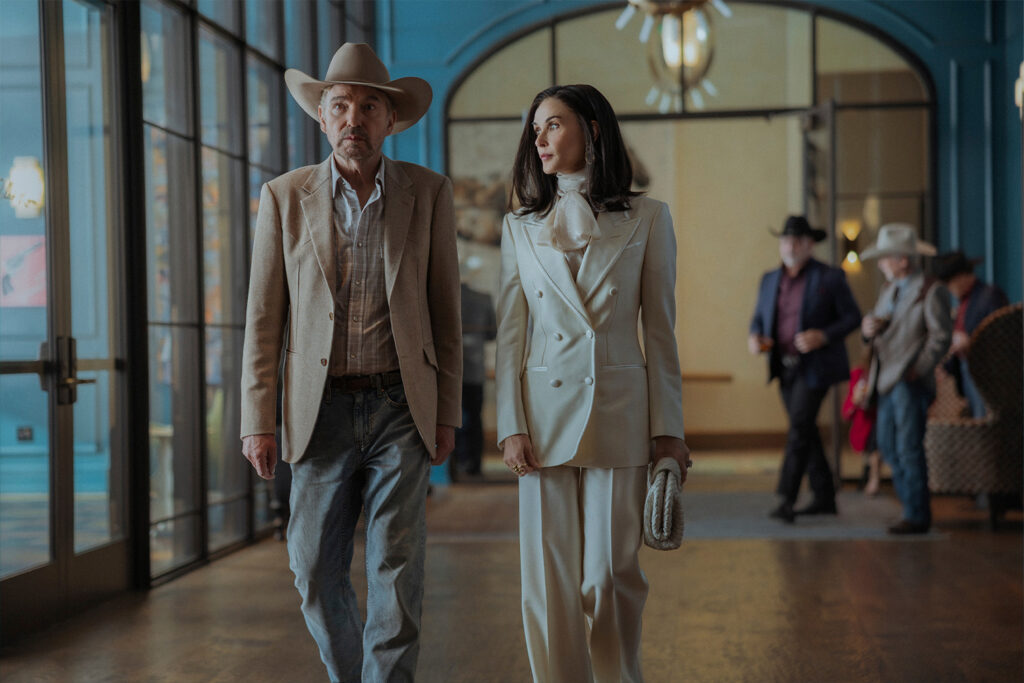
Below, Demi Moore tells us about filming Cami Miller’s arc in Season 2 of Landman.
Congratulations on the second season of Landman. What was it like to return to Cami Miller’s headspace after some time away?
“I mean, I was so excited because really, in the first season, I didn’t have as much of a chance to really dive in, to really find her. In truth, I had been really waiting to get back in there. I knew going into the first season that it was really all about this one.”
When we first meet Cami in Season 2, she’s in the bathroom and a pair of women say, “It’s a young woman’s game here.” Cami responds, “I needed that.” What was it like to explore those age dynamics within Cami’s headspace?
“I think it was less about it being about that, as much as having the spark of fire to not be underestimated. To take control. [The scene] just kind of gave a spark of owning who she was, to be able to step out in front of everyone and let go of her nerves, her fear, her uncertainty. What I shared is that, for Cami, the idea of losing the company would be like losing the last piece of Monty that she had left.”
Right. And Cami is in the middle of a storm: losing her husband, taking control of this company—she’s dealing with all of this internal chaos, yet she presents a very strong part of herself. What was your experience with embodying that tension? How did you get into character?
“Well, I think the baseline of what’s going on is the grief and loss that she’s dealing with. Just like in life, we can have something devastating going on, and then we still have something else that pulls our attention. So for me, it was just about really keeping the body of that, and using that as what was also driving her. It wasn’t really just the business—certainly not about the money—but [it was] about really holding on to the love that kept her together with her husband.”
When you’re on set and really getting into character, channeling some of these deeper emotional moments, are there rituals, or a method, that help you tap into the headspace of someone in the middle of this grief?
“For me, [it] is really just doing my pre-work so that I feel very alive, you know? So that I’ve already done my work—before I ever show up on the set—so that it’s already living in me as much as possible. So that I can also let all of that go and just be present for the scene.”
Without spoiling anything—is there a character shift or a moment that you’re excited for audiences to see? Is there a message that you’d like viewers to take away from the second season?
“I think the only thing I can really tease up without giving anything away is the idea that, for Cami, life may not be all that it seems—and what that means and what she has to deal with. [Laughs.] Does that help? It’s so hard! I can’t give anything away.”
Feature image courtesy of Paramount.
This transcript has been edited and condensed for length and clarity.