
As the awards season heat intensifies, with Wicked: For Good firmly secured on the shortlists for the Oscars, Golden Globes and Critics Choice Awards, the visual magic of Oz is the talk of town.
Paul Tazewell, who won Best Costume Design for Wicked last year, has taken the foundation of the first film and evolved it into something more mature, intricate and deeply symbolic for the sequel. “Many of the changes are because they are maturing as women,” Tazewell explains. “They are realizing who they are and what their own clothing sensibility is.”
Become an S Insider
The latest in fashion, beauty, design, and arts & culture.
I was in New York City to celebrate the home entertainment release of Wicked: For Good where the team took over the Arte Museum for media and creators, displaying several Immersive, multi-sensory spaces inspired by the world of Wicked, animation room, tornado content capture room and Costumes and props from Oz. No doubt, the costumes are a character themselves, reflecting who the women are turning into. I screened the exclusive Making Wicked: For Good featurette (which will be included in the digital release available on December 30) inside the museum’s cutting-edge digital space, complete with sweeping visuals, atmospheric sound and large-scale abstract projections that beautifully brought the world of Wicked to life.
Elphaba: The Mutation of the Witch

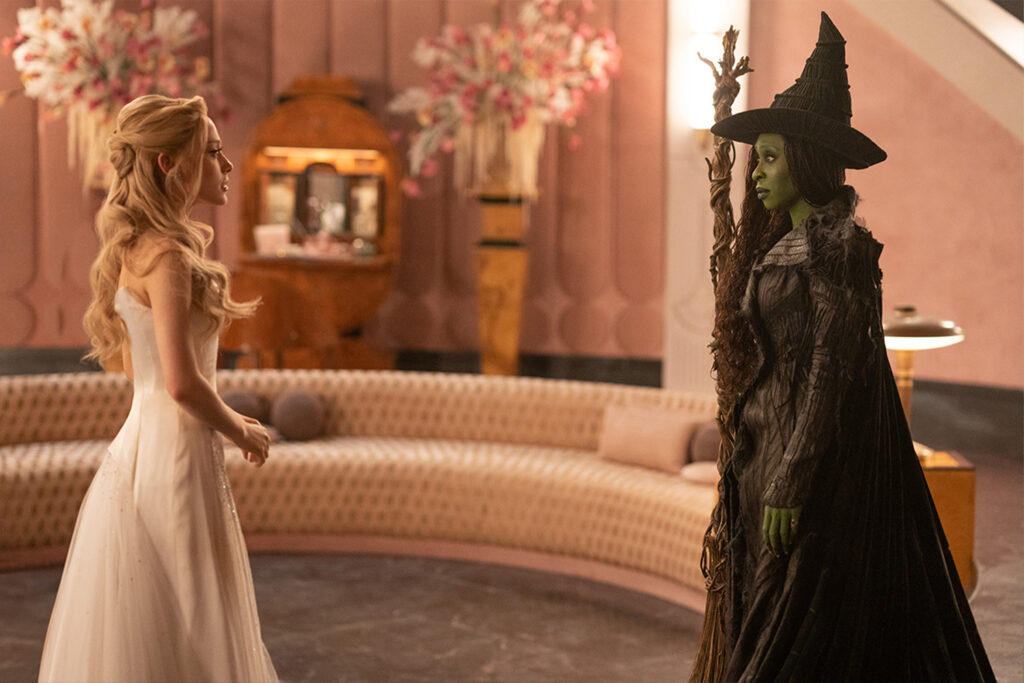
For Elphaba, the sequel is about the hardening of an icon. Living in exile, her wardrobe has become a map of her survival. Her fashion moves away from the structured uniforms of Shiz and into an organic, battle-worn aesthetic. Tazewell describes her look as a “mutation” of her core self rather than a total departure.
Even while living in a nest, Tazewell notes that she is “definitely in control of how she is going to present.” To emphasize this, he evolved her iconic hat, making the brim just slightly bigger and the peak a little bit taller,” he says. “It feels more solidly her.”
Her wardrobe literally maps her journey across Oz. “Her clothing has started to distress and fall apart,” Tazewell observes. “You see the remnants of her dress that we ended the first film [with]. This weathering serves to ground the character, showing that she hasn’t let go of who she was, but has “mutated into more of who she is and wants to be.”
Glinda: The Evolution of Iridescence

While Elphaba’s look becomes more distressed, Glinda’s wardrobe enters a realm of high-fantasy elegance, moving beyond her signature “Think Pink” palette.
The Lavender Bubble Dress: The sequel introduces a second version of the iconic bubble dress. Moving away from pure pink, this version is lavender with a “watery feel” and a unique iridescence. Tazewell’s goal was to give the garment a “magical quality” that reflects her new, more complex public persona.
The Wedding Gown Breakdown
Tazewell admits that designing a wedding dress is “daunting because there’s going to be a lot of focus on it.” The skirt is engineered with multiple layers of tulle and satin organza, designed specifically to “float” as she walks down the aisle. Butterflies are concentrated at the hem and swirl upward throughout the skirt and the look is topped off with a 25-foot long veil and a tiara featuring crystallized butterflies.
For the film’s grand centrepiece, Tazewell leaned into director Jon M. Chu‘s love for spectacle. Ariana Grande herself called it a bucket-list moment, noting, “Jon Chu does wedding scenes better than anybody in the world.”
Fiyero: Weaving the Scarecrow
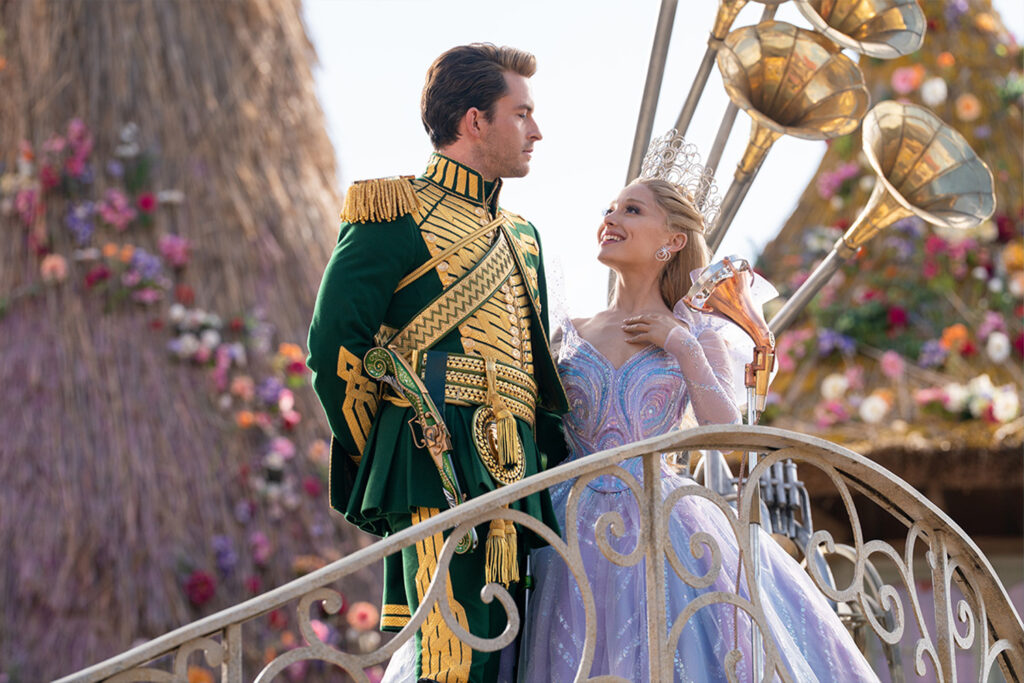
Perhaps the most technical feat in the sequel is the transition of Fiyero’s uniform into the Scarecrow silhouette. Tazewell wanted the costume to be a literal reflection of where the character comes from. He custom-wove all the banding on the uniform using straw and gold thread to create “scarecrow decoration.” You see the same banding positions from his royal uniform, but “rendered in different material.” As the curse takes hold, the fashion physically changes: his shirt turns to sackcloth and his boots begin to grow and curl at the toes, creating the legendary silhouette through fabric rather than just effects.
By grounding these fantastical designs in tactile materials like organza, sackcloth, and gold-woven straw, the costumes turn into the visual heartbeat of the characters’ growth. With Wicked: For Good leading the technical shortlists, these designs are the ones to beat as we head toward the Academy Awards. In the meantime, we suggest Oz fans to dive into the digital features that allow you to bring the world of Oz right at home.
Wicked: For Good will be available for digital purchase and rental on December 30.
Feature image courtesy of Universal Pictures.