
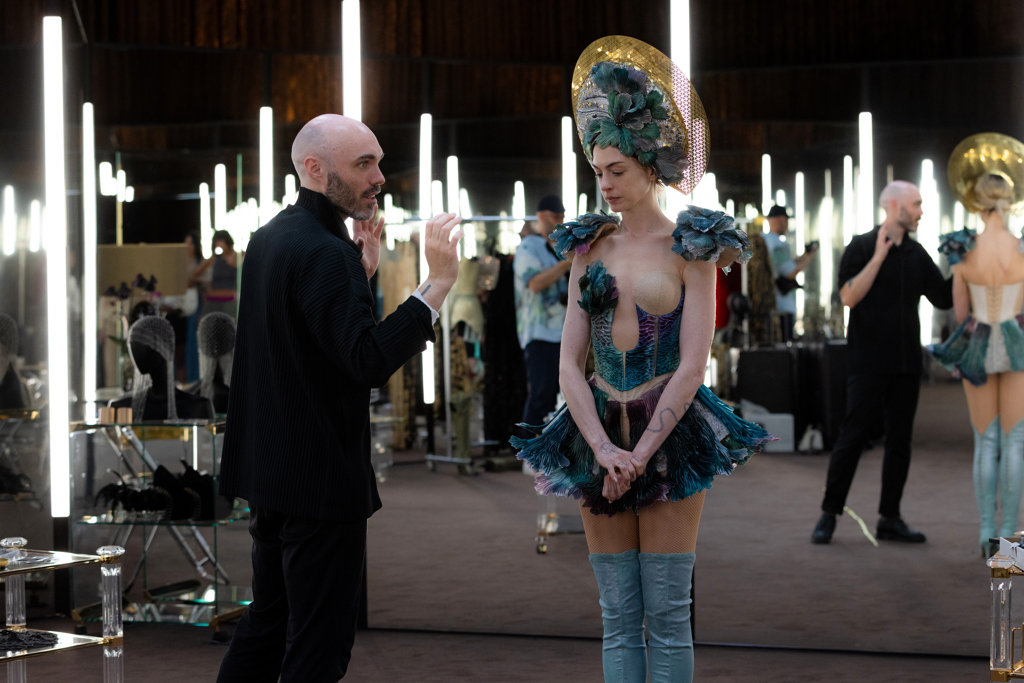
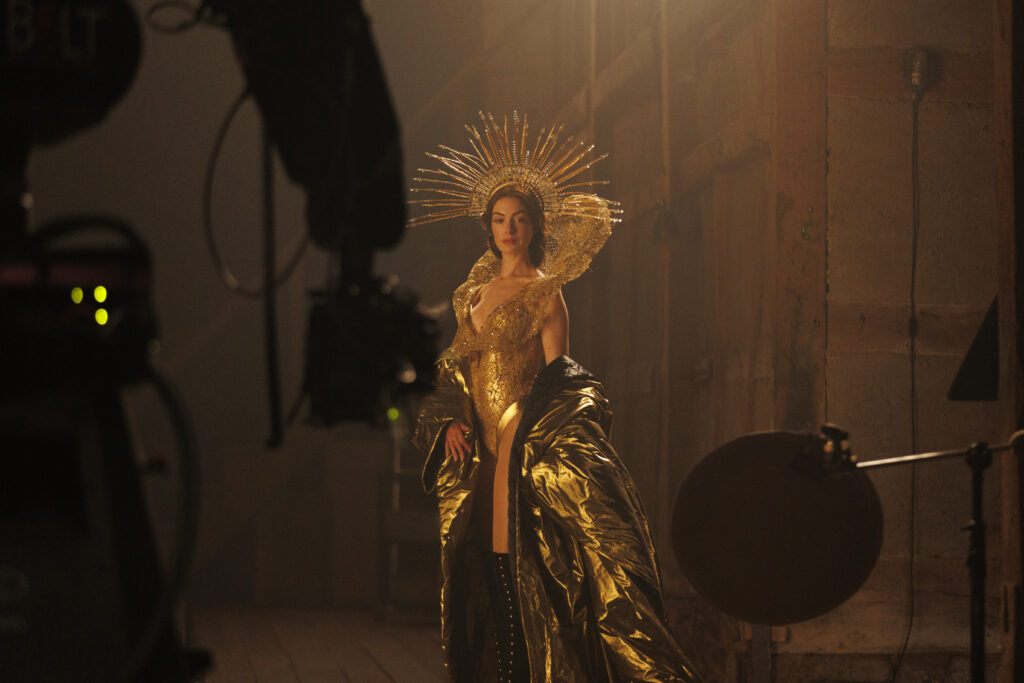
In the neon-lit, halo-inspired pop slick world of David Lowery‘s Mother Mary, Anne Hathaway embodies the titular divine pop star clad in tectonic couture and fueled by the raw energy of a woman pushed to her absolute limit; a global icon teetering on the edge of a breakdown, or perhaps, a breakthrough.
The A24 film follows a pop star as she’s trying to recover from a public and personal crisis. She connects with her estranged designer friend Sam Anselm (Michaela Coel) as she needs a new outfit days before a major comeback.
Become an S Insider
The latest in fashion, beauty, design, and arts & culture.
Speaking with director David Lowery and Hathaway, the conversation quickly turns to the sheer, bruising physicality of the role. To play Mother Mary, Hathaway had to shed the safety of the actress and embrace the nerves of a woman who is her own greatest product.

The role was a “vulnerable” trifecta of acting, dancing and singing at a world-class level. The preparation was a few years of descent into the character’s psyche.
“I felt very lucky. David’s script was so vivid and beautiful and sort of emotionally compelling that I felt like I had a bleed into the characters emotional landscape,” Hathaway says, reflecting on the vividness of Lowery’s script. “One of the other things that I confirmed with David was that Mother Mary has learned patter. She’s learned audience interaction. You can see that a little bit in the scene with FKA twigs. She knows how to host conversations but she actually is a pretty inarticulate person, which was one of the things that drew her to Sam, who’s a hyper articulate person initially.”
The character’s desperation fuels the film’s centerpiece: a raw, music-less barn dance that is undoubtedly Hathaway’s stand-out scene. “I knew that I was going to have to push myself to go there,” said Hathaway. “I also knew it was really important when we got to the concert stuff, that when you see her, you believe that people have been fans of hers for 20 years and that they would drop everything and buy a ticket to one of her concerts.”
While Mother Mary exists in a state of permanent exposure, Hathaway is candid about her own equation with fame, describing a slow-burn ascent that she intentionally disrupted to preserve her artistry.
“I think I was kind of awkwardly famous for many years,” Hathaway admits. “I would do a film, and then I would become well known to six-year-old girls, or I would do a film and I would become well known to the audience of that film. But I don’t think that I actually really achieved the kind of recognition that I have now until fairly recently.”
“Now that it’s happening, I’m really able to see where the line is between who I am as a person and the sort of, you know, glamor that you have to put on when you’re facing the world,” she adds.
That shift in movie roles was a conscious choice. Following the massive, culture-shifting success of The Devil Wears Prada, Hathaway felt the walls of public perception closing in.
“When Devil Wears Prada came out I kind of saw how huge that was and I decided to take a step back from doing that type of role,” she explains. “It seemed like it would be playing into people’s fixed ideas of what I was capable of and I wanted to challenge myself. I wanted to grow as a performer, as an artist, as an actress, as a person and so I kind of pushed myself more towards the margins. I tried to challenge myself with different roles.”
For Hathaway, the equation of fame for an actress involves a necessary layer of separation – an interpreter that stands between the human and the audience. For a pop star like Mother Mary, that interpreter is stripped away.
“The difference between me and Mother Mary is Mother Mary has no filter between herself and her fame, like she is her own fame,” she muses. “It just kind of goes with the territory of being a pop star. You can’t escape your own face.”
“I just feel like actresses and actors get to disappear,” Hathaway continues. “We express ourselves through a filter. We express ourselves through an interpreter and so that feels very different to me.”
While Mother Mary is overwhelmed by the weight of her success, Hathaway views her relationship with her audience through a lens of profound respect. For her, the currency of fame is about the value of the exchange.
“I think I have a lot of faith in my fans. I think that because I’ve explored so many different types of movies, and I’m lucky enough to have people like you who have followed me through them, I think my fans are willing to kind of get weird, and I appreciate that.”
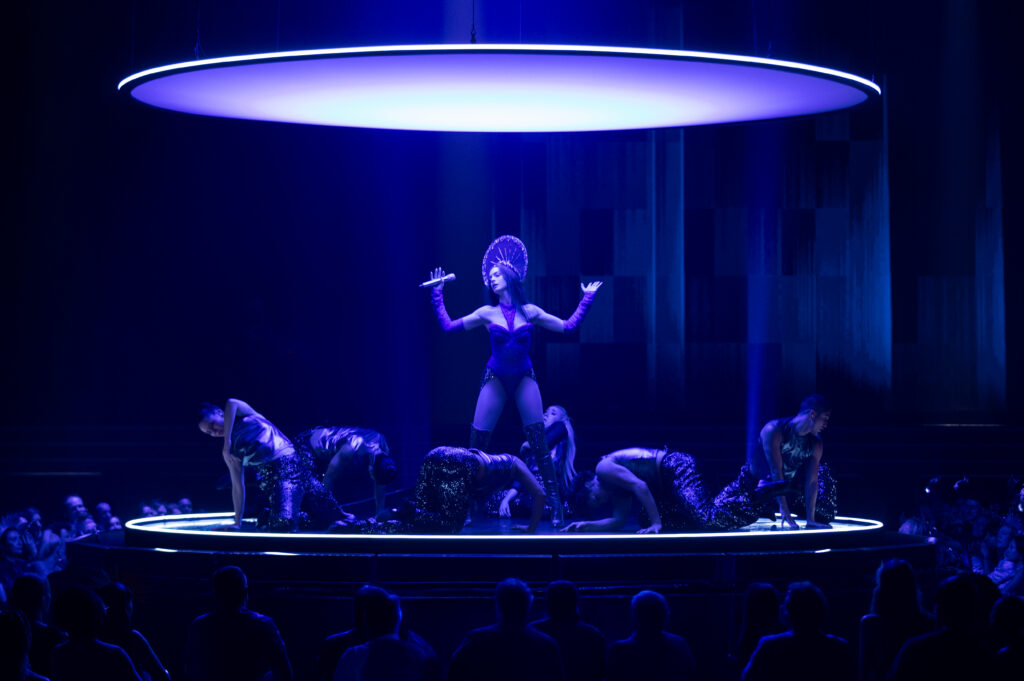
“The only thing that I’m really thinking about with them is, ‘Am I comfortable asking for your time and your money?'” Hathaway notes. “I don’t want to ever put out a film that isn’t worth your time. You don’t have to love it or like it, but hopefully… it’s thoughtful and in terms of money, I mean, my God, everybody worked so hard and asking somebody to spend money on something that you created, or were a part of creating, I take that very, very seriously.”
To build the iconography of a modern legend, Lowery turned to the biggest star in the world’s orbit: Taylor Swift. Specifically, the dark, stadium-filling defiance of the Reputation era.
“For me, it was really watching her documentary films,” Lowery admits. “Specifically, the Reputation tour was one that I returned to over and over again… the scale of it was unlike anything I’d ever seen before. It really felt like she was at the center of a galaxy when she was on that stage and every star in the universe was turned towards her and every one of those stars was a person in the audience who was having a very intimate connection with her and that felt unexpectedly profound to me.”
Hathaway found her own bridge to the character through Swift’s Miss Americana, noting the “transformation and metamorphosis” of an artist letting go of one side of the pool before reaching the other.
“I just appreciated watching her go between the raw singer-songwriter, artist state to the completely glossy, couldn’t-be-more-glamorous pop star,” she says. “Also, David made this playlist… Anti-Hero was on that one. It was just this magic song… it just kind of reminded me that that’s what we were going for.”
By stripping away Hathaway’s traditional safety net and embracing the raw, unfiltered exposure of a pop icon, she has delivered a performance that is as much an athletic feat as it is an emotional exorcism.
Mother Mary is in theatres Friday.
Images courtesy of A24.